Showing posts with label Plato. Show all posts

Sunday, May 4, 2025

MENO'S PARADOX AND THE THEORY OF RECOLLECTION

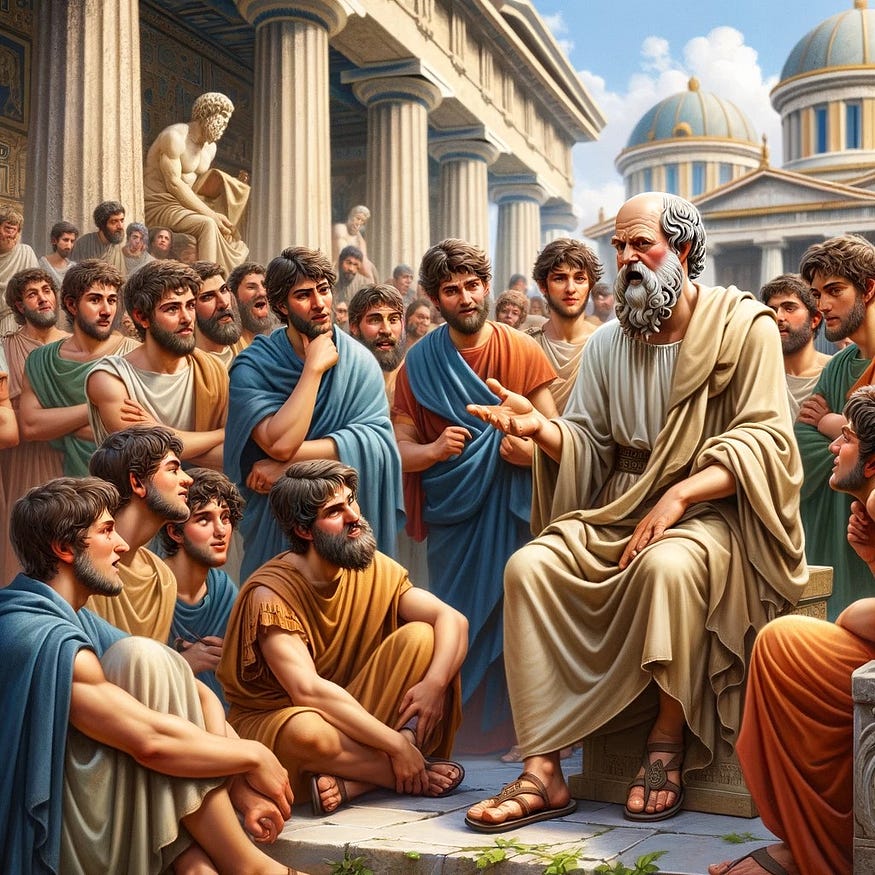
Plato meditating on immortality before Socrates
Plato Thinking About the Afterlife


Plato's Meno: Paradox and Solution


In the dialogue Meno, Plato writes that after repeated failures to provide Socrates with an adequate definition of virtue, the character Meno complains that Socrates may not be able to inquire about virtue at all.  If we know what virtue is, then there is no need to inquire about it.  If we don’t know what it is, then “even if you do happen to bump right into it, how do you know that it is the thing you did not know?”  Plato has Socrates rephrase Meno’s complaint as follows: 

 …it is not possible for a person to inquire about what he knows, or about what he does not know.  After all, he wouldn’t inquire about what he knows—once he knows it, and there is no need to inquire about something like that— or about what he does not know—since he does not know what he is to inquire about.  (80e)

Scholars call this Meno’s Paradox. We might all agree that if we already know the definition of virtue, then there is no need to inquire about the definition.  It is the second option that troubles us.  If we do not know what virtue is, then how are we to go about our inquiry?  How will we know when we have found correct or incorrect answers to our question about the nature of virtue?  It is like being told to find the length of the third side of a triangle having a perimeter of 50 with two sides equal in length and the third side having a length that is more than 5 times that of the equal sides.  How will we know the correct answer when we come across it?   If we happen to bump into the correct number how will we know that it (20) is correct rather than some other number (15 or 25)?    

Socrates accepts the challenge. He responds by making a number of claims.  Let us look at these by using the following strategy. We will begin by locating the main conclusion(s) of the argument(s) that Socrates advances (What is he attempting to prove?)  Next, we will identify the reasons (if any) provided by Socrates for the conclusion reached, showing how he moves from these reasons (premises) to the conclusion.  This will prepare the groundwork for any criticisms we wish to make.  Does Socrates succeed?  Is the proof logically sound?  Are the premises true?  Do the premises support the conclusion?  Finally, we might want to show how we would answer the same question, taking care of the reasons that we think support an alternative solution.


Here are the main conclusions that Socrates advances in his ensuing dialogue with Meno:  

1.     If learning something new is unnecessary or impossible (as proved by Meno’s Paradox), then it must be that what we (mistakenly) think we are learning for the first time is actually something we already know, and we are merely recollecting what we already know.

2.     If we are recollecting what we already know, then we either acquire the knowledge we are recollecting in this life or in a previous life.

3.     There is no evidence that we acquire the knowledge in this life.

4.     Therefore, we must have acquired what we know in a life that is previous to this life.

5.     If we lived a previous life, then we lived it as a disembodied soul.

6.     The soul is immortal (meaning that it will never cease to exist).

Socrates supports premise 2 with an explanation of how it is possible to inquire about that which we do not know.  His solution is the theory of recollection.  We are able to inquire (or learn) because inquiry is a process of recollecting what we already know but have forgotten.  Plato attempts to prove this to Meno by means of his interview of a slave-boy.  He asks several questions that lead the young boy, who has never been taught geometry, to recognize that a particular geometrical theorem must be true: A square whose area is twice that of a given square is the square on the diagonal of the given square.   Let us refer to this theorem as P, and put the time of day at which tSocrates questions the slave-boy at 10 am, and the time the boy acquires the knowledge that P is true at 10:30 am.  Socrates then proposes the following argument[i] as valid:

a.       At 10:00 am it appears that the boy does not know that P. 

b.       At 10:30 am, after being asked a long series of questions, the boy knows that P. 

c.       The boy does not acquire the knowledge that P during the interval between 10:00 and 10:30 am.

Socrates thinks that (b) is obviously correct, since it is only at 10:30 am that the boy can give proof that P is true. And he thinks that (c) is correct since Socrates did not do any “teaching” - he only asked questions.  But (b) and (c) entail that what appears to be true in (a) is not true - at 10:00 am the boy must have known ‘that P’, since he knows it at 10:30 am and didn’t acquire the knowledge in the interval between 10:00 and 10:30 am.


If (a) is mistaken, then the boy did know ‘that P’ before Socrates began asking his questions.  The questions asked by Socrates must have caused the slave-boy to recollect, that is the slave-boy recovers the knowledge “from inside himself” (85d).  Since no one has ever taught the boy geometry (according to Meno), he did not get this knowledge in his present life.  Hence, he must have got it at some other time, “at that time, then, when he was not a human being” (86a).  


The general conclusion of the discussion is that we can inquire about the nature of virtue, and we can do this in the same way that the slave-boy comes to profess true beliefs about the geometrical theorem P.  There are true beliefs in us about the nature of virtue. 

These beliefs can only result in knowledge after we are subjected to a process of questioning, and we recollect these beliefs.  As to the metaphysical question about when we originally acquired these beliefs Socrates pronounces that they have always been in us.  “For it is clear that for all time we either are or are not human beings… Then if the truth about the things that are is always in our soul, the soul is immortal.”


[i]       I owe both the construction of this argument and the comments following it to Professor S. Marc Cohen (Lecture notes, University of Washington, 2016). 


Sunday, April 13, 2025

EUTHYPHRO: AN EXAMPLE OF SOCRATIC METHOD, Part 3


From  Understanding Plato: The Smart Student's Guide to the Socratic Dialogues and the Republic


A foundational figure in Western philosophy, known for his Socratic method.


EUTHYPHRO: EXAMPLES OF SOCRATIC METHOD

Part 3


Concurrence of the Gods

Euthyphro now makes a third attempt (D3) to provide a definition.  I’d say that the pious is what all the gods love, and its opposite, what all the gods hate, is the impious” (9e).  Socrates responds by asking a question that some scholars have called one of the most important questions in the history of philosophy: “Is the pious loved by the gods because it’s pious?  Or is it pious because it’s loved?” (10a). The question is important because it proposes a dilemma.[1] No matter what choice Euthyphro makes the result is unacceptable (R3).

Here are the choices: (1) If the pious is loved by the gods because it is pious, then the piety of an action has nothing to do with whether or not the gods love it.  For example, if the gods love Euthyphro’s act of prosecuting his father for murder, and they love this because it is pious, then we can still ask the question “Why do the gods believe that what Euthyphro did is pious?”  If the gods tell us their reasons for believing this, then these reasons are accessible to everyone, not just the gods.  But more important than that, we still have no answer to the question “What makes an action pious or impious?” 

(2) If an act is pious because it is loved by the gods, then it is logically possible that any act, even the most heinous act imaginable, could be pious.  All that is needed to guarantee this is that the gods love it.[2] Hence, it is possible that Euthyphro’s act of prosecuting his father would be pious if the gods love it, but it is also possible that the gods could love the Holocaust, and if they did love the Holocaust, then this would also be pious.  This is the unacceptable result of a theory that makes the moral quality of an act (the quality of being right or wrong, good or bad, just or unjust) utterly dependent on an emotional response (love, approval, desire), whether it is a response of the gods or of humans.[3]  

Once again, we see the elenchus at work.  If piety is what all the gods love, and it is possible that all the gods love (for example) torturing innocent children, then it is possible that torturing innocent children is pious.  But we can safely assume that the torture of innocent children is not a result that Euthyphro would ever accept as a pious act.  Therefore, he must abandon his hypothesis (“piety is what all the gods love”).


[1]A dilemma requires a choice between options that either are or seem equally unfavorable or unsatisfactory.

[2] Professor S. Marc Cohen has an amusing way of making this criticism.  He says that Euthyphro’s proposed definition leads to something like (what I’ll call) the Kim Kardashian Paradox.  Kim is famous.  She appears on talk shows, reality TV shows.  Everyone knows who she is.  But what does Kim do? What is she famous for? As Cohen’s joke goes, “She is famous for being famous”. But that is just to admit that there really isn’t any reason for Kim Kardashian to be famous. We are all making the same mistake by paying any attention to her. The analogy to Euthyphro’s definition of piety is obvious. If piety is being god-loved, then the gods are all making a mistake in admiring an act for its piety.  They are admiring nothing other than their own admiration.

[3]  Later philosophers have used Socrates’ counter argument to criticize The Divine Command Theory of Ethics. This theory says that the morality of an action depends upon whether the act does or does not violate a command of God.  This raises the question “Does God command this particular action because it is morally right, or is it morally right because God commands it?” It is in answering this question that the divine command theorist encounters the same difficulty encountered by Euthyphro (For more on this dilemma see Michael Austin’s article in Internet Encyclopedia of Philosophy).


EUTHYPHRO: EXAMPLES OF SOCRATIC METHOD, Part 2


 From Understanding Plato: The Smart Student's Guide to the Socratic Dialogues and the Republic


A foundational figure in Western philosophy, known for his Socratic method.


Part 2 Quarreling Deities

Socrates repeats his request:  What are the pious and the impious?”  Euthyphro responds by telling Socrates that "what's loved by the gods is pious, and what's not loved by the gods is impious" (7a).  Let's call this new definition D2.

Socrates responds to D2 by saying that it implies the contradiction that one and the same action can be both pious and impious at the same time.  This implication is clearly unacceptable.  Socrates proves this by getting Euthyphro to admit that the gods quarrel and disagree about such issues as "the just and the unjust, fine and shameful, good and bad" as much as any group of human beings.  This is in marked contrast to differences about height and weight in which we can "turn to measurement and quickly put a stop to our differences" (7c).   But absent such standards, it is possible that "what you're now doing in prosecuting your father was something pleasing to Zeus but displeasing to Cronus and Uranus, or lovable to Hephaestus and displeasing to Hera, and similarly for any other gods who may differ from one another on the matter" (8b).   Hence, prosecuting your father is both pious and impious. We will label this lengthy reply R2.

Something extraordinary has happened as a result of this short back-and-forth between Socrates and Euthyphro.  Some would call this a “take-down,” using a term from the sport of wrestling to describe a humbling refutation of a claim or argument of one’s opponent. How did this happen? C.D.C. Reeve points out that Socrates’ style of questioning is called (by us, not him) an elenchus—derived from a Greek verb meaning “to examine or refute”:

[Socrates] asks what [piety] is; his interlocutor [Euthyphro] puts forward a definition he sincerely believes to be correct, at least for the moment; and Socrates refutes this definition by showing that it conflicts with other beliefs the interlocutor sincerely holds and doesn’t think he can reasonably abandon.  In the ideal situation, which is never actually portrayed in the Socratic dialogues, this process continues until a satisfactory definition emerges—one that is not inconsistent with other sincerely held beliefs, and so can withstand elenctic scrutiny (Reeve, 2012, viii).

Euthyphro puts forward D2, and Socrates refutes it with R2.   But R2 (“one and the same action cannot be both pious and impious at the same time”) is a belief that (we presume) Euthyphro “sincerely holds.”  Since Euthyphro cannot reasonably abandon R2, he must abandon D2, and the elenctic process continues.   If we put this in standard argument form, it would look like this:

1.  Hypothesis: What is loved by the gods is pious and what is not loved by the gods is impious (D2). 

2.  It is possible that some gods love what Euthyphro did to his father and some gods do not love this.

3.  If some gods love what Euthyphro did to his father and some gods do not love this, then what Euthyphro did to his father is both pious and impious (R2)

4.  It is a contradiction to say that what Euthyphro did to his father is both pious and impious (It is assumed that a contradiction is unacceptable to Euthyphro).

5.  Therefore, the hypothesis (D2) is false, that is, it is not the case that what is loved by the gods is pious and what is not loved by the gods is impious.

Euthyphro now sidesteps the problem by raising a different point: the gods all agree "that anyone who has unjustly killed another should be punished" (8b).  Socrates responds that both the gods and humans agree that the unjust should be punished, but second, he also observes that this is beside the point.  The point is that both the gods and humans disagree about what actions are unjust, not about whether the unjust should be punished (8e).  "I think that men and gods who argue...argue about actions.  It's about some action that they differ, some of them saying “that it was done justly, others unjustly" (8e).