:max_bytes(150000):strip_icc()/GettyImages-526606460-5c4f500cc9e77c00014afc37.jpg) |
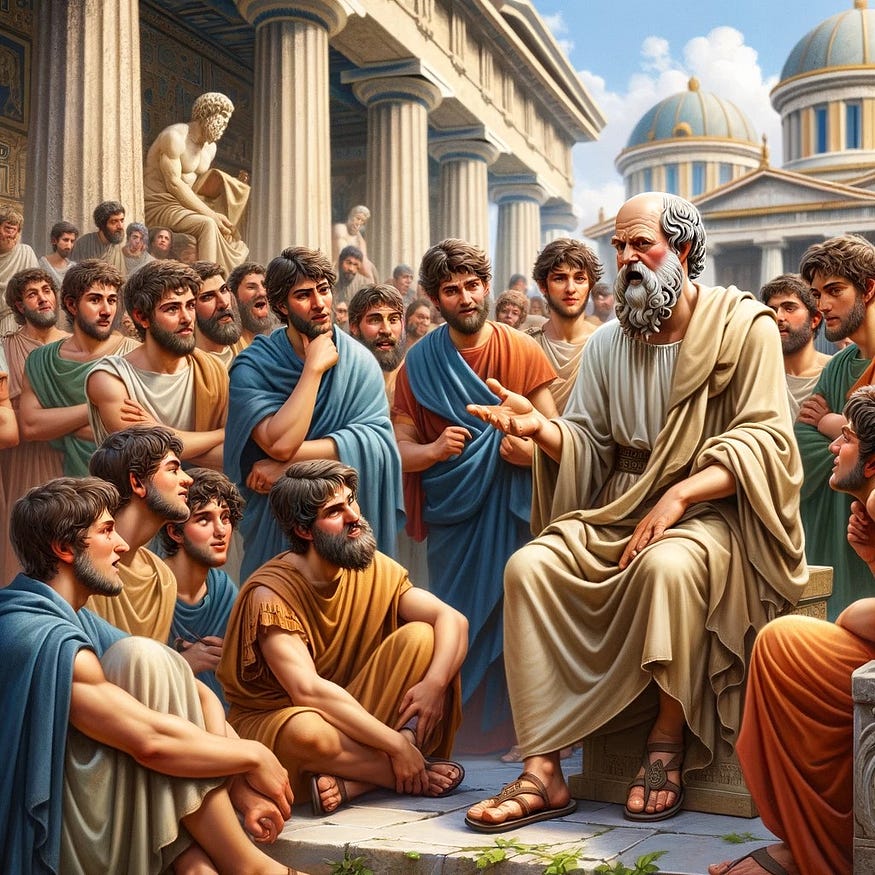
| Plato Thinking About the Afterlife |
Plato's Meno: Paradox and Solution
In the dialogue Meno, Plato writes that after repeated failures to provide Socrates with an adequate definition of virtue, the character Meno complains that Socrates may not be able to inquire about virtue at all. If we know what virtue is, then there is no need to inquire about it. If we don’t know what it is, then “even if you do happen to bump right into it, how do you know that it is the thing you did not know?” Plato has Socrates rephrase Meno’s complaint as follows:
…it is not possible for a person to inquire about what he knows, or about what he does not know. After all, he wouldn’t inquire about what he knows—once he knows it, and there is no need to inquire about something like that— or about what he does not know—since he does not know what he is to inquire about. (80e)
Scholars call this Meno’s Paradox. We might all agree that if we already know the definition of virtue, then there is no need to inquire about the definition. It is the second option that troubles us. If we do not know what virtue is, then how are we to go about our inquiry? How will we know when we have found correct or incorrect answers to our question about the nature of virtue? It is like being told to find the length of the third side of a triangle having a perimeter of 50 with two sides equal in length and the third side having a length that is more than 5 times that of the equal sides. How will we know the correct answer when we come across it? If we happen to bump into the correct number how will we know that it (20) is correct rather than some other number (15 or 25)?
Socrates accepts the challenge. He responds by making a number of claims. Let us look at these by using the following strategy. We will begin by locating the main conclusion(s) of the argument(s) that Socrates advances (What is he attempting to prove?) Next, we will identify the reasons (if any) provided by Socrates for the conclusion reached, showing how he moves from these reasons (premises) to the conclusion. This will prepare the groundwork for any criticisms we wish to make. Does Socrates succeed? Is the proof logically sound? Are the premises true? Do the premises support the conclusion? Finally, we might want to show how we would answer the same question, taking care of the reasons that we think support an alternative solution.
Here are the main conclusions that Socrates advances in his ensuing dialogue with Meno:
1. If learning something new is unnecessary or impossible (as proved by Meno’s Paradox), then it must be that what we (mistakenly) think we are learning for the first time is actually something we already know, and we are merely recollecting what we already know.
2. If we are recollecting what we already know, then we either acquire the knowledge we are recollecting in this life or in a previous life.
3. There is no evidence that we acquire the knowledge in this life.
4. Therefore, we must have acquired what we know in a life that is previous to this life.
5. If we lived a previous life, then we lived it as a disembodied soul.
6. The soul is immortal (meaning that it will never cease to exist).
Socrates supports premise 2 with an explanation of how it is possible to inquire about that which we do not know. His solution is the theory of recollection. We are able to inquire (or learn) because inquiry is a process of recollecting what we already know but have forgotten. Plato attempts to prove this to Meno by means of his interview of a slave-boy. He asks several questions that lead the young boy, who has never been taught geometry, to recognize that a particular geometrical theorem must be true: A square whose area is twice that of a given square is the square on the diagonal of the given square. Let us refer to this theorem as P, and put the time of day at which tSocrates questions the slave-boy at 10 am, and the time the boy acquires the knowledge that P is true at 10:30 am. Socrates then proposes the following argument[i] as valid:
a. At 10:00 am it appears that the boy does not know that P.
b. At 10:30 am, after being asked a long series of questions, the boy knows that P.
c. The boy does not acquire the knowledge that P during the interval between 10:00 and 10:30 am.
Socrates thinks that (b) is obviously correct, since it is only at 10:30 am that the boy can give proof that P is true. And he thinks that (c) is correct since Socrates did not do any “teaching” - he only asked questions. But (b) and (c) entail that what appears to be true in (a) is not true - at 10:00 am the boy must have known ‘that P’, since he knows it at 10:30 am and didn’t acquire the knowledge in the interval between 10:00 and 10:30 am.
If (a) is mistaken, then the boy did know ‘that P’ before Socrates began asking his questions. The questions asked by Socrates must have caused the slave-boy to recollect, that is the slave-boy recovers the knowledge “from inside himself” (85d). Since no one has ever taught the boy geometry (according to Meno), he did not get this knowledge in his present life. Hence, he must have got it at some other time, “at that time, then, when he was not a human being” (86a).
The general conclusion of the discussion is that we can inquire about the nature of virtue, and we can do this in the same way that the slave-boy comes to profess true beliefs about the geometrical theorem P. There are true beliefs in us about the nature of virtue.
These beliefs can only result in knowledge after we are subjected to a process of questioning, and we recollect these beliefs. As to the metaphysical question about when we originally acquired these beliefs Socrates pronounces that they have always been in us. “For it is clear that for all time we either are or are not human beings… Then if the truth about the things that are is always in our soul, the soul is immortal.”
[i] I owe both the construction of this argument and the comments following it to Professor S. Marc Cohen (Lecture notes, University of Washington, 2016).